



New Electric Press Brakes
The electric press brake represents one of the most significant engineering breakthroughs in sheet metal bending over recent years. Developed to meet rising market demands for high precision, energy efficiency, and reduced operating costs, it has firmly established itself in modern fabrication facilities as a superior and sustainable alternative to conventional hydraulic technology.
How an Electric Press Brake Works
Unlike a hydraulic press brake, which generates bending tonnage through a pressurized oil circuit, an electric press brake transmits drive power to the upper ram via electric servomotors coupled to mechanical drive systems—primarily heavy-duty synchronous belts, precision ball screws, or dual-drive combinations. These servomotors receive commands directly from the numerical control in real time, delivering exceptionally precise ram positioning and far superior repeatability compared to conventional hydraulic systems.
The entire bending cycle is governed digitally. Approach speed, pressing force, punch bottom-dead-center position, and springback compensation are calculated and adjusted dynamically by the CNC control. This eliminates external process variables caused by hydraulic oil thermal expansion, valve drift, or system wear. As a result, the machine ensures identical angular accuracy from the first part of the morning shift to the final run of the night.
Advantages of Electric Press Brakes
The primary operational benefit over competing technologies is energy consumption. An all-electric press brake draws power only when the ram or backgauge is actively in motion, whereas a hydraulic unit runs its main pump motor continuously throughout idle and setup phases. In high-volume production, this direct-drive efficiency cuts electricity consumption by over 50 percent compared to an equivalent-tonnage hydraulic machine.
The total elimination of hydraulic oil is another major advantage. It eliminates fluid leak risks, avoids hazardous waste disposal costs, and makes electric press brakes ideal for clean-room and contamination-free environments—such as food processing, medical hardware, electronics enclosures, and architectural stainless steel fabrication. Consequently, electric bending is widely recognized as a sustainable, green manufacturing solution across its entire service life.
Acoustic noise levels are significantly lower than those of hydraulic machines, noticeably improving shop-floor working conditions and reducing environmental noise exposure. Maintenance overhead is also minimized because all typical hydraulic failure points are eliminated: hydraulic pumps, proportional valves, filters, high-pressure hoses, seals, and oil reservoirs.
Precision and Speed in Sheet Metal Bending
Electric press brakes excel in fabrication jobs demanding micron-level repeatability and tight angular tolerances. High-torque servomotors respond to CNC velocity and position loops within milliseconds, achieving ram positioning accuracy measured in hundredths of a millimeter ($\pm0.01$ mm). This deterministic control is essential for batch production where part-to-part bend angle consistency must remain strictly uniform.
Cycle speeds deliver another measurable productivity advantage. The ram accelerates and decelerates smoothly through optimized S-curves, reducing non-productive approach and retract intervals. On complex parts requiring multiple bend sequences per sheet, this dynamic responsiveness translates to higher parts-per-hour output than hydraulic press brakes of comparable tonnage.
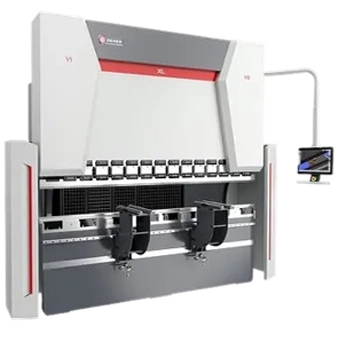
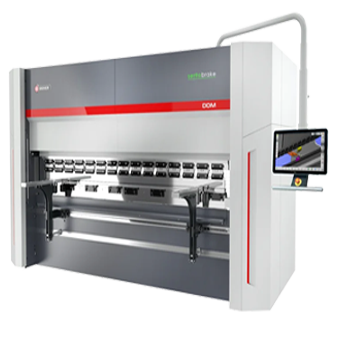
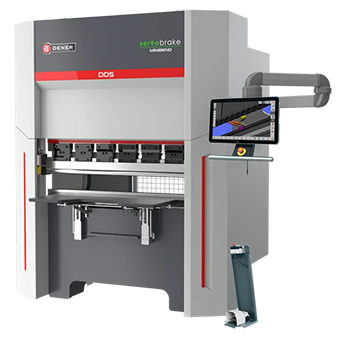
Innovation Engineered by Dener: In electric bending technology, solutions from Dener represent the industry benchmark for mechanical reliability and control software. Dener electric press brakes are engineered to optimize servomotor torque curves, pairing intuitive touchscreen CNC interfaces with high-rigidity mechanics that slash tool setup times. Investing in a Dener electric press brake provides an Industry 4.0-ready production asset built for smart factory automation.
Review full technical specifications: Explore the Dener Electric Press Brake Range
Electric Press Brakes: Key Applications and Suitability
All-electric bending technology is tailored for medium-to-high production runs where absolute angle consistency is mandatory. Light and medium sheet metal fabrication, electrical cabinets, IT chassis, electronic enclosures, precision brackets, and thin-gauge architectural panels represent the ideal applications where electric brakes maximize ROI.
For heavy plate processing or extremely high tonnage requirements exceeding 150–200 tons, hydraulic press brakes remain the industry standard. For light to medium applications, however, electric press brakes offer an unbeatable combination of speed, low operating costs, and clean operation that offsets their initial capital investment through substantial power and maintenance savings.
Fabricators seeking high mechanical stiffness combined with electric drive dynamics can explore our ball screw press brakes, an advanced solution utilizing recirculating ball screws for high-load durability. If you are looking to expand production capacity with a lower initial outlay, our certified used press brakes offer fully inspected, high-performance machines ready for production.
Explore Related Categories
-
Press Brakes – Comprehensive overview of all CNC sheet metal bending solutions
-
Hydraulic Press Brakes – High-tonnage capacity engineered for heavy plate forming
-
Ball Screw Press Brakes – Precision screw-driven technology for high speed and durability
-
Dener Brand – Advanced manufacturing technology for industrial bending

Showing all 8 resultsSorted by latest
-
View Product
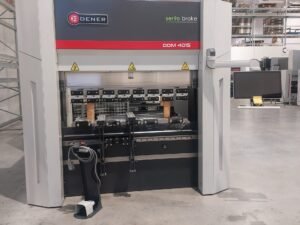 Power:40 TonNumerical control:Esa 840Year:2025
 -
View Product
 Power:40 TonNumerical control:Esa 875Year:2025
 -
View Product
 Power:20 Ton - 40 TonNumerical control:Esa 875Year:2025
 -
View Product
 Power:50 TonNumerical control:Esa 875Year:2025
 -
View Product
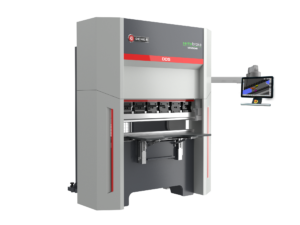 Power:20 TonNumerical control:Esa 875Year:2025
 -
View Product
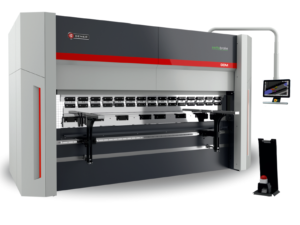 Power:130 TonNumerical control:Esa 875 WYear:2025
 -
View ProductPower:50 TonNumerical control:Esa 875Year:2025
-
View Product
 Power:20 TonNumerical control:Esa S630 WYear:2022